


You answered the sources sought with a capability statement. That's why you're competing on price.
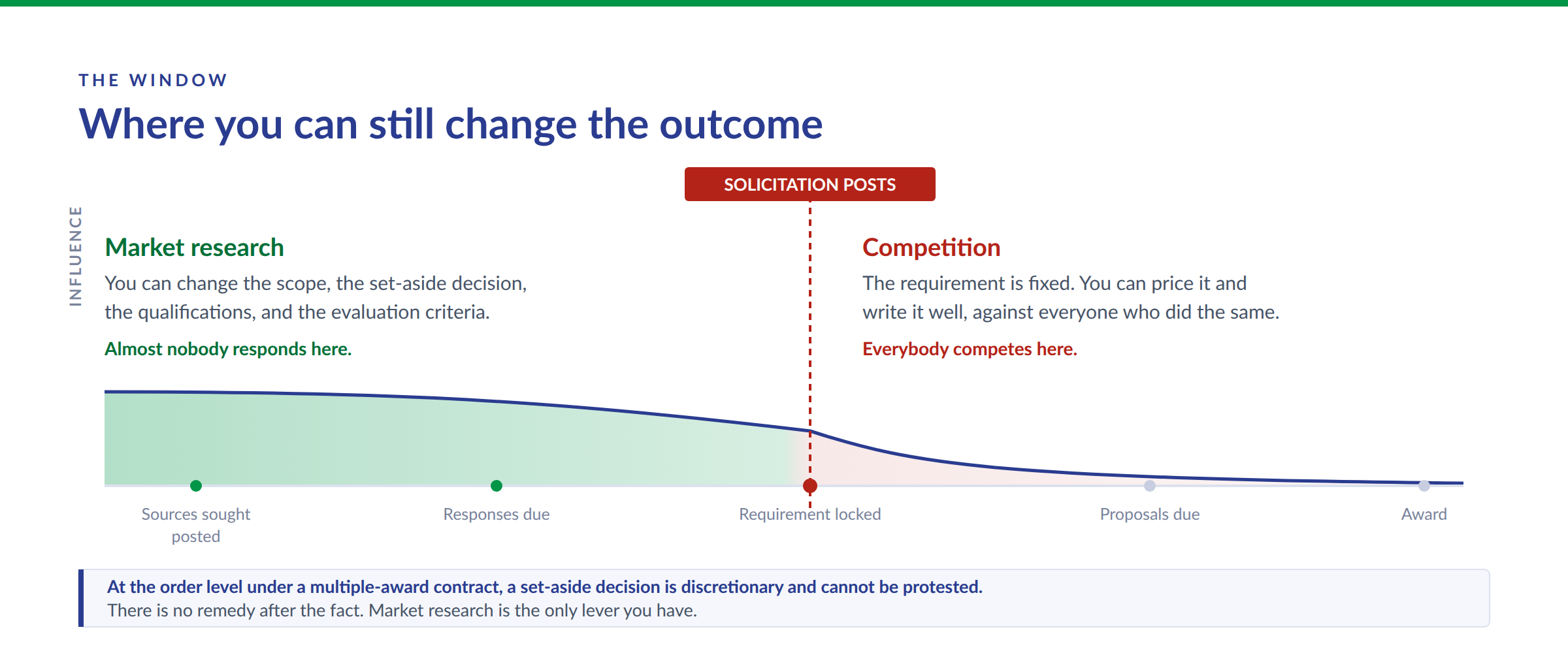
Market research is the last point where a small business can still change a federal requirement. Once the solicitation posts, you're one of nine firms answering someone else's questions. This tool builds the response that gets in earlier.
$25. One file. Runs in your browser.

THE PROBLEM
Most firms answer a sources sought notice by sending a capability statement. Who we are, what we do, contracts we hold. Contracting officers do not read those closely, because they answer a question nobody asked.
A contracting officer running market research is trying to answer three things: can I set this aside, is my requirement written correctly, and who else can do this. A capability statement answers none of them directly.
That gap is the opportunity. A response that gives a CO something to put in the market research file is rare enough to be memorable, and it takes about ninety minutes.
WHAT IT DOES
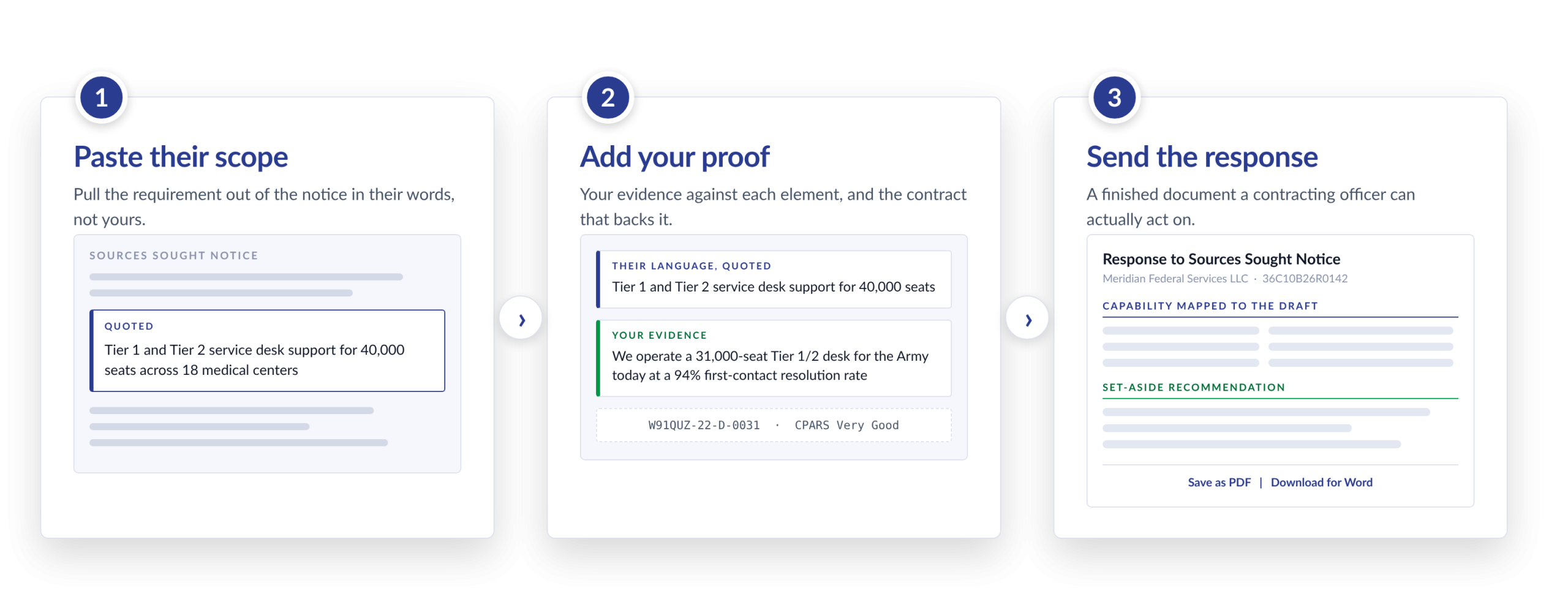
Their scope language is quoted on the left, your evidence and the contract that proves it on the right.
Enter the limit from the notice. It warns you before you go over, not after.
How much of the response influences the requirement, updated as you type.
A live checklist of what would make a contracting officer act on it.
WHAT YOU GET
-
The tool, a single HTML file that opens in any browser
-
A two-page Start Here guide
-
Twenty-one lines of tested phrasing for set-aside arguments, scope changes, restrictive qualifications, and evaluation criteria
-
Word and PDF export, branded to your company
-
Single-company license, unlimited internal use, twelve months of updates
Frequently Asked Questions
What is the Sources Sought Response Builder?
It's a browser-based tool that structures your market research response element by element, scoring how much of your draft actually shapes the requirement while you write. You download it once, it runs in your browser, and nothing you type ever leaves your machine.
What's the difference between a market research response and a proposal?
A market research response answers the contracting officer's three questions: Can I set this aside? Is my requirement written correctly? Who else can do this work? A proposal is a formal bid to win the work. The tool builds the first one. It's where shaping happens, before the requirement is locked.
How does the shaping strength score work?
The tool scores your draft in real time as you write. If your response reads like a capability statement (who you are, what you do, contracts you hold), the meter tells you. If it reads like evidence toward a set-aside, a specific fix to the requirement, or a clear map of the field, the score moves. The score tells you whether you're influencing the requirement or just describing your company.
Can I use it if the agency lists specific items they want addressed?
Yes. If the notice says "provide the following information" and lists items, paste that list in and the tool builds your response in their order under their headings. That's what they asked for, and the sample shows what it looks like when you deliver exactly that.
What should go in the set-aside recommendation section?
Name the other small businesses you found in SAM.gov or through research that can do the work at comparable scale. How many did you find? Which ones? The contracting officer needs those names to write the market research memo justifying the set-aside. That section is the single most valuable paragraph in any market research response, and most firms don't write it at all.
What are "observations on the draft PWS"?
Problems with the requirement as written, and specific fixes. In the sample, the respondent identified three: the government-to-contractor ratio isn't stated (so offerors price blind), the ticketing platform might change mid-contract (undefined risk), and the nine-month clearance timeline excludes firms that can't get people cleared fast (narrows the field unnecessarily). Each observation names a problem and a fix the contracting officer can act on. This is where you change the requirement.
Why does length matter?
The sample response covers a 15-page limit in under three pages. That's not because the firm left things out; it's because every paragraph answers something the agency asked for. If your response is shorter than the limit and you're not leaving gaps, shorter is a strength. It means you're answering their questions, not padding with marketing.
Does the tool help with set-aside language?
Yes. It includes tested phrasing for set-aside recommendations and for requirement observations, so you don't start from a blank page. The tool also tells you if your draft still reads like a generic set-aside argument instead of evidence the CO can cite.
Can I use my company's branding?
Yes. When you first open the tool, fill in your company name, logo, colors, and typeface choice. Your branding appears on every response you build. You choose between plain professional (the right choice for market research) or your full brand colors.
What formats can I export to?
PDF and Word. The PDF is the default and carries your logo. The Word export lets you keep editing, but it doesn't embed images, so your logo won't appear in Word unless you add it manually. For market research submissions, PDF is the standard choice.
How does page tracking work?
You enter the page limit from the notice and the type size it requires (Times New Roman 10 point, Arial 12, etc.). The tool tracks your current page count as you write and turns red when you go over. The count is an estimate based on word count rather than true pagination, so leave yourself a margin if there's a hard limit.
Does the tool work offline?
Yes. It makes no network calls and has no external dependencies. Turn your wifi off and it behaves identically. That matters if you work on a restricted network, and it means your draft scope language and pipeline data never leave your machine. There is no server.
How long does a response take to write?
The sample response covers a full eight-item notice in under three pages and was written in about ninety minutes. Time depends on how much research you've done beforehand and how many requirements you're responding to, but the tool is built for one sitting.
Is this the same as writing a proposal?
No. Market research is discovery: does this requirement make sense as written, and who can do it? A proposal is the formal answer to "give us your best price and approach to win the work." Market research happens before the requirement is final. The tool is for the first one.
Can I respond to multiple notices at once?
Yes. Each response saves separately in your browser. You can have three open at the same time if you want, switching between them. Nothing you type in one response carries over to another unless you copy it yourself.
What if I clear my browsing data?
It's gone. The tool saves everything in your browser, not on a server. Clearing cache clears the work. If you want to save a response before you close the browser, export it as a PDF or Word file and keep it. You can reimport and edit the Word version later if needed.
How do I know the tool scored me right?
The sample response in the documentation ran through the full eight-item notice, included a set-aside recommendation, and added three specific requirement observations. The tool scored it 100 out of 100 on shaping strength. Read the sample and compare it to your draft; if yours answers the same kinds of questions, your score should move the same way.
What's the license?
Single company, unlimited internal use by every employee of that company for that company's own pursuits. One license, one company, unlimited users at that company. Team, reseller, and white-label licenses are available; reply to your order confirmation to ask about those.
How long is the license valid?
Twelve months from purchase, which includes updates to the phrasing library and any changes to FAR language or regulatory notes. Every file carries a version number and issue date, so you always know which version you're running.
What if I want to ask the tool a question while I'm writing?
The tool doesn't answer questions. It scores your draft and flags when your response still reads like a capability statement. For help with content, the included phrasing library covers set-aside recommendations and requirement observations, which are the two hardest things to write. For everything else, use the FAR and your subject matter knowledge.
Does the tool handle sole source responses?
No. The tool is built for market research, which assumes there's a competitive field. Sole source notices of intent and award announcements look the same label on SAM.gov but aren't requests for a response at all. Read the notice carefully before you start writing.
What if the notice has unusual requirements?
The tool handles the standard case: scope language, evidence of capability, set-aside analysis, and requirement observations. If the notice requires you to fill out government-supplied forms, use those forms and use the tool to think through your content. The tool creates the narrative response; it doesn't replace agency-required attachments.
Can I see a sample before I buy?
Yes. The documentation includes a complete response to a real federal sources sought notice, produced exactly as the tool exports it. Read that sample; it shows what you're building and how the tool structures evidence, set-aside rationale, and requirement observations.
Is there a money-back guarantee?
Yes. If your first response doesn't sharpen your next market research work, reply to your receipt and we'll refund it. No questions, no timeline.
Where do I find the FAR citations?
The tool references FAR Part 10 (market research), FAR Part 19 (small business set-asides), and FAR 52.219-14 (small business subcontracting). You can verify everything in the tool at acquisition.gov. The tool is not legal advice; verify your own facts against primary sources.
How much does it cost?
$25. One file. Runs in your browser. Twelve months of updates included. Link in bio or comments.
THE PROOF
Tested against twenty live notices.
We pulled twenty real sources sought and RFI notices from SAM.gov across eight NAICS codes and ran each one through the tool. Roughly half worked as they came. Most of the rest worked once the agency's required item list was pasted in. Six were not requests for a response at all, which is its own lesson about where firms waste time.
What it does not cover
It cannot fill out government-supplied forms, and it will not help with sole-source notices of intent. If the notice requires attachments, use the attachments.
$25.
Download link sent by email after payment. Single-company license, twelve months of updates. Business tool, not legal advice.